
Why Uncovering Anonymous Users Is Bad for Business
Anonymous visitor identification tools promise more emails and revenue, but stale data, poor consent, and damaged sender reputation can make them bad for ecommerce.
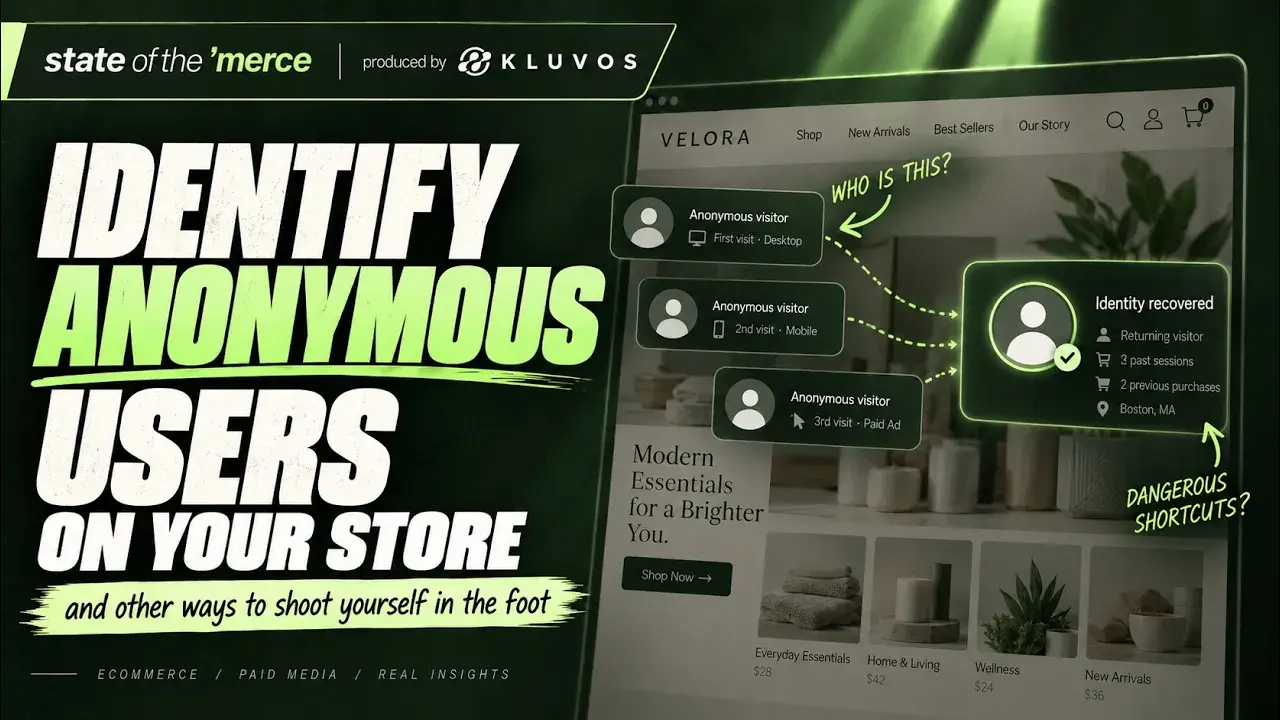
So you want to uncover the email address of every visitor who lands on your ecommerce store? Don’t do it.
There are apps that create value by uncovering the email addresses, and sometimes phone numbers, of people who visit an ecommerce store without ever identifying themselves. These visitors haven’t subscribed to a list, filled out a form, made a purchase, or otherwise given the brand permission to market to them. These tools “identify” users through aggregated 3rd party data sources and then push that information into platforms like Klaviyo.
There are certainly legal and privacy questions around that practice, but even setting those aside, there is a significant business problem. Anonymous visitor identification obtained through 3rd party data can create a long-term liability for a brand, especially when it comes to data quality, customer trust, email deliverability, and sender reputation.
The Temptation to Identify Every Visitor
Most of the traffic on your store is anonymous. A store may know that somebody viewed a product, added something to a cart, or spent several minutes browsing, but unless that person identified themselves, there is usually no deterministic way to know exactly who they are. There is no confirmed email address or phone number and no direct channel through which the brand can reach back out, outside of advertising platforms like Meta, Google, or TikTok.
That creates an obvious gap, and marketers naturally want to fill it. There has always been a temptation in digital marketing to gather as much information as possible: Who was that visitor? How can that person be reached again? How can more value be extracted from traffic that would otherwise disappear?
Gary Vaynerchuk has a memorable line: “Marketers ruin everything” — which is an apt description of the current issue. When marketers discover a loophole that provides access to additional information or additional eyeballs, the instinct is often to exploit it. Anonymous visitor identification feeds directly into that impulse.
But just because there is a gap in the data does not mean the gap needs to be exploited. In this case, exploiting it can create problems that are much more expensive than the short-term revenue it produces.
How Anonymous Visitor Identification Works
The technology can vary between providers, but the basic model is fairly straightforward. A visitor lands on a Shopify or ecommerce store, perhaps from a Facebook ad, TikTok, Google search, or another source. An app installed on the store collects signals about that visit, which may include device information, network information, IP-related data, browser characteristics, or other identifiers.
That information is then compared against data held by a third-party data provider. These providers have accumulated large datasets connecting people with devices, IP addresses, email addresses, phone numbers, locations, and other signals. The system may determine that a particular device or network pattern is likely connected to a certain person and then return an email address or phone number associated with that profile.
The key word is likely.
This kind of identification is often probabilistic rather than deterministic. The system may have enough signals to say that a visitor is probably a particular person, but that does not mean the match is correct. Even when the identity itself is correct, the contact information may be old, incomplete, or inaccurate.
The app then takes that probabilistic match and, in many cases, creates what looks like a completely normal customer profile inside an ESP such as Klaviyo.
That is where the real problem starts.
Probabilistic Data Starts Looking Like First-Party Data
Once one of these profiles appears inside Klaviyo, it can look almost identical to somebody who actually subscribed. There may be a name, email address, phone number, location, browsing history, and other customer information attached to the profile. From the perspective of somebody managing the account, it looks real.
But the origin of that profile is fundamentally different.
A legitimate subscriber provided an email address directly to the brand. An anonymous-identification profile may have been assembled from multiple external sources and matched using probabilities. Those two datasets should not be treated as interchangeable.
The information may also be badly outdated. An old email address may still be connected to someone. A phone number may have changed ownership. A device may be shared between several people. An IP address may represent a household, workplace, VPN, mobile carrier, or other network rather than a single individual.
The result is a seemingly clean customer profile built on information that may be stale, incomplete, or simply wrong.
And once that data is mixed into the rest of an ecommerce brand’s customer database, determining which profiles can actually be trusted becomes much harder.
It Turns Klaviyo Into a Cold Email Tool
This may be the biggest practical problem with anonymous visitor identification through 3rd party data aggregation.
Klaviyo functions primarily as a warm marketing platform. Customers subscribe, purchase, start checkout, fill out forms, or otherwise interact directly with a brand. Those first-party interactions provide the foundation for subsequent email and SMS marketing.
Anonymous visitor identification changes that model.
Instead of communicating primarily with people who have identified themselves, a brand begins importing contact information obtained through outside data sources and probabilistic matching. Klaviyo starts functioning less like a warm email platform and more like a cold outreach tool.
That has consequences.
Suppose a campaign is sent to recent subscribers or people supposedly engaged during the last 30 days. Mixed into that segment are now profiles created through anonymous identification. Some of the addresses are stale. Some belong to people who never asked to receive marketing. Some may not even belong to the person who actually visited the website.
Over time, those contacts are less likely to open emails, click through, or engage positively. Some may mark messages as spam. Others simply ignore them. That behavior slowly works its way into the metrics that matter: open rates, click-through rates, bounce rates, spam complaints, domain reputation, and overall sender reputation.
The email program becomes weaker because the underlying audience has become weaker.
The Short-Term ROI Can Be Misleading
This is also why these tools can appear extremely compelling at first.
An anonymous visitor identification app might generate impressive numbers during the first several weeks or months. Thousands of additional profiles appear inside the ESP. Some percentage of those people open an email. Some click. Some make a purchase. A dashboard can then point to those purchases and claim incremental revenue.
That does not mean the tool is healthy for the business.
The costs associated with poor data quality and sender reputation accumulate slowly. They may not become obvious during the first eight weeks or even the first quarter. A brand can continue loading questionable contacts into its ESP while the immediate revenue numbers still look positive.
Eventually, however, the account may begin wondering why open rates are declining, why inbox placement is getting worse, why campaigns are producing less revenue, or why supposedly engaged segments contain large numbers of people who barely interact.
There is rarely one single explanation for declining email performance, but continually introducing stale, probabilistically matched contacts into an ESP can absolutely contribute to the problem.
That is what makes evaluating these tools based entirely on attributed revenue so dangerous. The revenue appears immediately. The damage shows up gradually.
Consent Is Actually Valuable Information
There is also a broader marketing lesson here. The fact that somebody has not identified themselves to a business is itself meaningful.
A visitor may browse several products and leave. Maybe the person was not ready to buy. Maybe the offer was not strong enough. Maybe the visitor simply did not want to receive emails from the company.
That does not necessarily represent a technological problem that needs to be solved.
Too much marketing technology is built around the idea that every unknown visitor represents failed identification. But the healthier approach is to give visitors a reason to identify themselves voluntarily. Build a better offer. Improve the popup. Create stronger content. Offer something useful. Improve merchandising. Give people a reason to subscribe.
Earn the identification rather than trying to reverse-engineer it.
A smaller database of people who actually want to hear from a brand is generally much more valuable than a massive database filled with uncertain identities and questionable contact information.
Pay Attention to Where These Apps Operate
Brands considering an anonymous identification product should also pay close attention to whether the company operates within the normal Shopify and Klaviyo ecosystems.
Shopify has requirements surrounding customer data and app behavior. Klaviyo similarly has requirements governing integrations and the handling of customer information. If a product that promises to identify anonymous website visitors cannot be found inside the normal Shopify or Klaviyo partner ecosystems, that should immediately raise questions.
That alone does not prove that a product is doing something improper, and being listed in an ecosystem does not automatically mean every possible use of a tool is advisable. But it is an important signal.
The Long-Term Tradeoff Is the Problem
The attraction of anonymous visitor identification is easy to understand. Ecommerce brands spend large amounts of money acquiring traffic, and most visitors disappear without purchasing or subscribing. Being able to identify more of those people sounds incredibly valuable.
But there is an important distinction between recognizing customers who have already identified themselves and attempting to uncover the identity of people who never provided that information.
Those are not the same thing.
Once an ecommerce brand begins creating customer profiles from scraped, stale, or probabilistically matched third-party data, uncertainty is introduced into one of the most valuable datasets the company owns. The brand no longer knows with confidence which profiles are accurate, which addresses are current, or whether the person attached to a profile actually wants to receive marketing.
The short-term numbers may still look good. There may be additional conversions, and a dashboard may show incremental revenue. But over months and years, the business is taking on a much larger risk: annoyed customers, polluted customer data, deteriorating engagement, and a damaged sender reputation.
A clean first-party dataset and a healthy email domain are enormously valuable assets.
Trading those assets for the ability to squeeze a little more information out of anonymous visitors is not a trade worth making.