
Server Side Tracking Needs Better Architecture
What a server does after it receives an event depends on architecture. A key-value routing lookup and an identity engine are not the same system.

One of our favorite topics to discuss around the topic of server-side tracking technology is the architecture. There are a lot of different solutions out there, and for a business owner or digital marketer, it can be confusing to sift through what’s happening behind the scenes. This is, fundamentally, an issue of architecture.
Server-side tracking can look very different from one system to another. That is to say, what a server (or app) does once it receives an event, can vary dramatically. The consequences of architecture impact a server’s ability to add value.
A lot of solutions function like a routing system with a simple key-value lookup. At Kluvos, we run a full application on the server that includes CPU, large data stores, background processing, and algorithms. It is designed more around discovery than it is around key-value pairs. Understanding these differences helps explain why two systems that might be perceived as doing the same thing, in fact, do different things underneath the hood.
How a routing system works
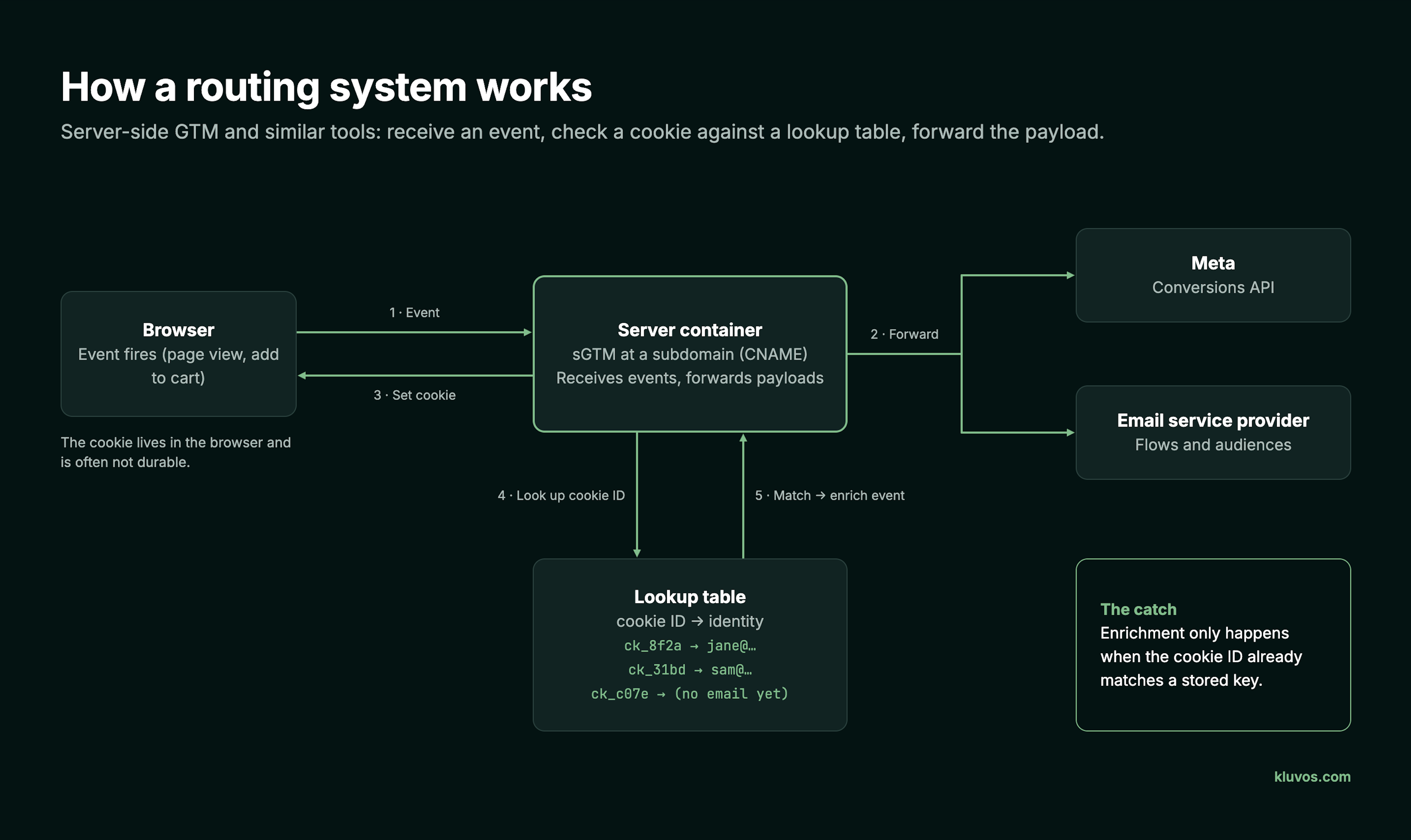
An easy example of routing architecture is server-side Google Tag Manager (sGTM). This type of system consists of a container on a server — perhaps hosted at a subdomain using a CNAME — which serves as an endpoint where events are ingested.
It works like this: a browser event hits the server, and the server sends a payload to its destination — maybe that’s Meta, or maybe an email service provider. The server responds with a cookie that is set in the browser (note that this is most likely not a durable cookie. See our previously published works on the myth of the CNAME record). Once a payload comes through with PII (email), that cookie can be resolved to an identity. Future events that share that cookie value can then be reconciled to an identity on the server and be enriched with additional data before being sent off to their final destination.
A lot of server-side apps work in a similar way.
There are benefits to doing this type of architecture; we don’t want to overstate the criticism. But, this is fairly unsophisticated and its utility will be limited.
What happens when the lookup fails
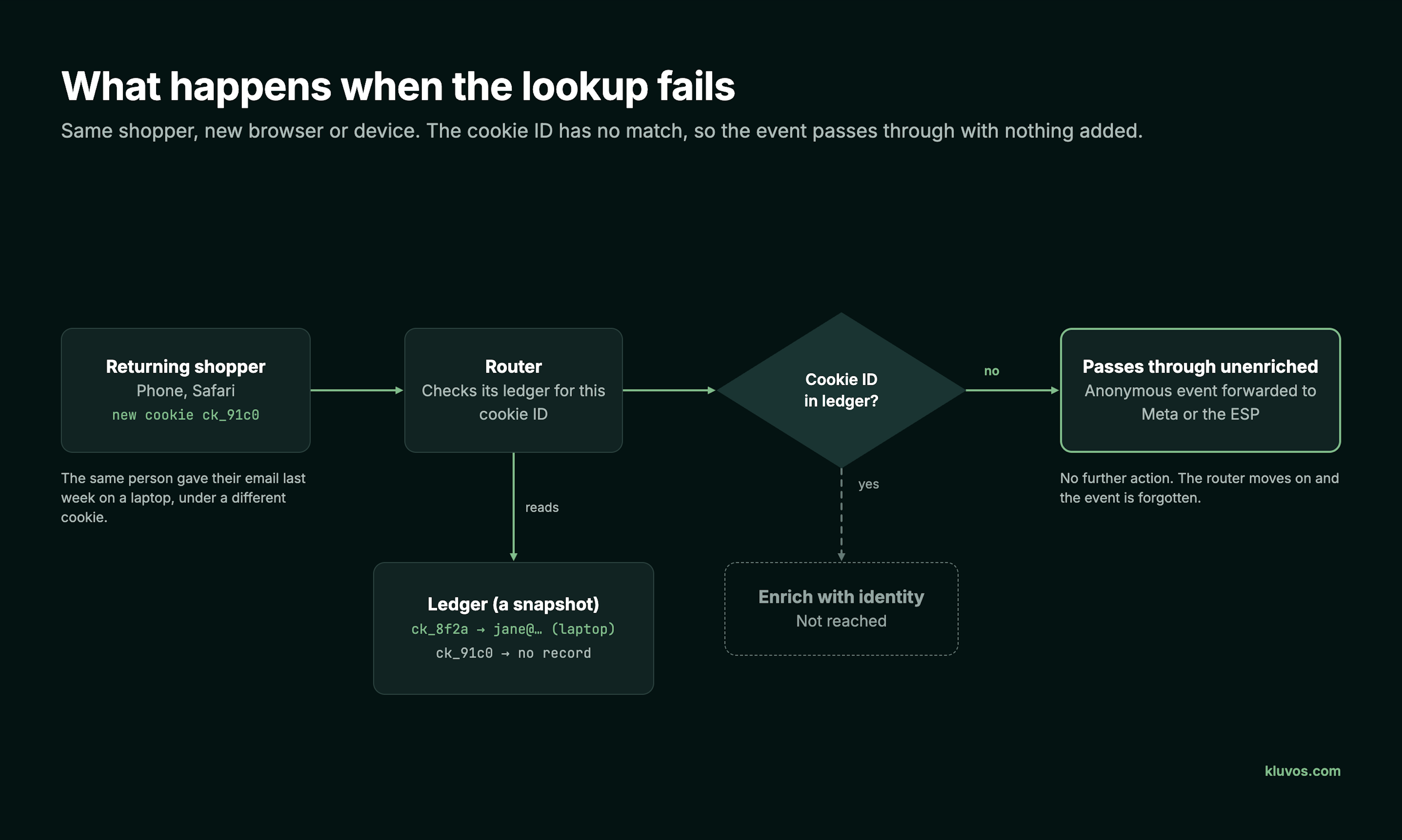
When a request comes through without a recognizable ID, the server will not be able to add value to that request. The event passes through and does not get the identity enrichment that a successful match would provide.
In a routing system, there’s no further action. The server checks its ledger, doesn’t find a match, and moves on.
One of the problems with this system is that the data stored on any given user is just a snapshot. In practice, user behavior is sporadic and can carry a variety of different states. People move between browsers and devices, and that creates different states and relationships that a cookie ID alone can’t represent.
If your system is dependent on that cookie, you’re going to miss things you could otherwise do with a more rigorous architecture.
An identity engine has more context to examine
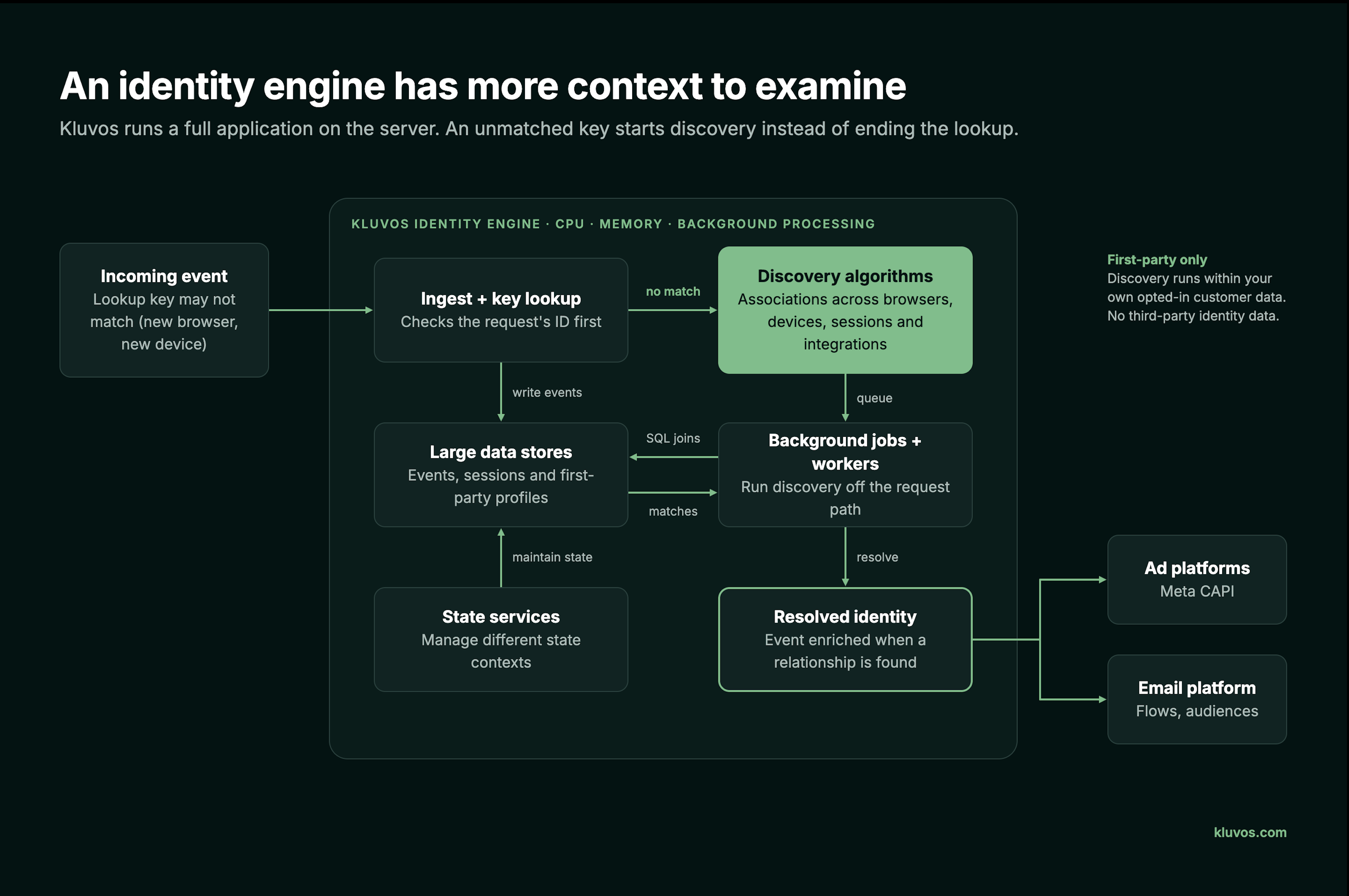
At Kluvos, we do something different. Instead of checking a key-value pair, our identity engine is involved with a more complex array of associations, lookups, and algorithms.
To put it simply, our identity engine is more about discovery than it is about a cookie ID.
The identity engine seeks to establish relationships between records despite a disruption of state between the server and client. There are complex SQL joins, background jobs, workers, and services maintaining state but also trying to understand the context behind requests where state may be disrupted.
Important context does not always exist in a key-value relationship. If a request arrives with an unmatched lookup key, our identity engine will seek to discover other relationships and associations that exist.
This requires a backend that is capable of doing heavy lifting.
More compute and more memory is required compared to a simple router architecture. There is more happening on the server because the system is doing more than checking whether the request matches a record in a lookup table before passing data through and forgetting the event.
Architecture affects what your tracking can recover
This discussion is, no doubt, tedious and ambiguous to some. But its importance for brands and digital marketers should not be overlooked. A router that depends on a shared ID is limited relative to an identity engine that can discover identity.
To be clear, that doesn’t mean every request will now result in a recovered identity. It does mean the engine has more to work with and more opportunity for discovery.
So when you’re evaluating server-side tracking solutions, don’t make the mistake of assuming all the solutions are the same. Take a moment to ask questions about the system or better yet, take it for a test drive.
Disclaimer
A quick note about the term discovery. Data privacy is important. When this article mentions discovery, the assumed context is that the user in question is someone who has already supplied the necessary data-privacy permissions. Kluvos does not communicate with 3rd party data providers to collect new email addresses or attempt to recover email addresses outside of those who have provided 1st party opt-in signals. Collecting 3rd party identities and using information obtained in this way can be harmful. We even wrote an article about it here.