
Event Match Quality is over-rated and misunderstood
The event match quality score in your events manager is perhaps the most misunderstood and over-valued metric in Meta ads. This article dices out the details.
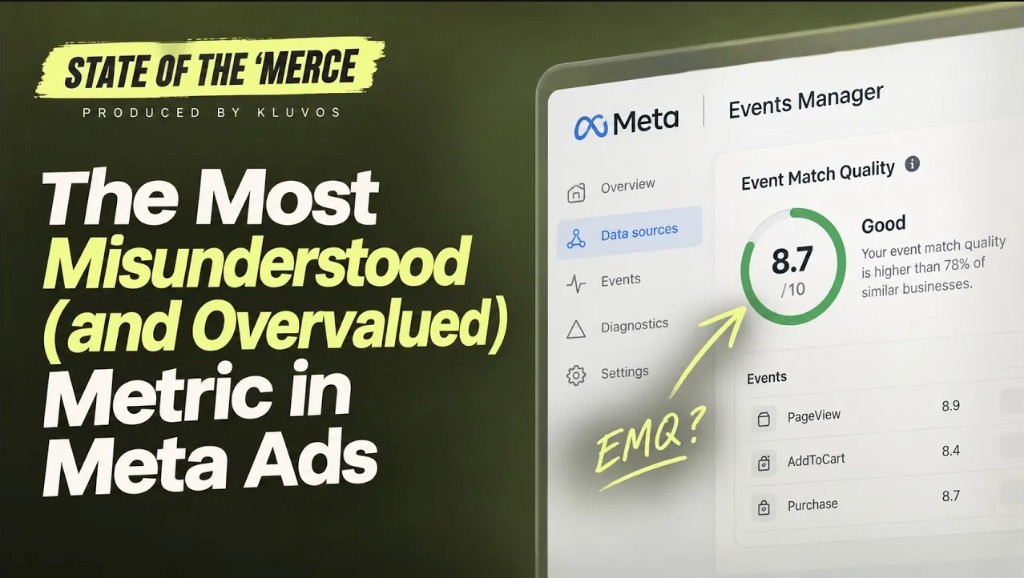
Your Event Match Quality went from 6.2 to 8.4, but your ads didn’t improve. Those two facts aren’t in conflict. Here’s why.
Open Meta Events Manager, click any event, and there it is: a number out of 10 with a colored bar behind it. Event Match Quality. It’s one of the most visible metrics on the screen, which makes it easy to overfocus on.
We ran into this ourselves while building the Kluvos Conversions API pipeline. When you’re the one deciding what gets sent to Meta and what doesn’t, you have to answer a specific question: what are we optimizing for? Depending on how you answer it, you get very different numbers in Events Manager and potentially very different results in the ad account.
EMQ is a real metric, and it’s worth watching. The danger isn’t the score. It’s elevating the score above the things that actually move performance.
What EMQ actually measures
A server event can carry identifying data alongside the event itself. Depending on what information is available, that can include hashed email or phone, name and location fields, IP address and user agent, and Meta identifiers such as the click ID (fbc) and browser ID (fbp).
Not every event carries all of these identifiers.
The important distinction is between what EMQ tells you and what people sometimes assume it tells you:
- It checks whether the field was there.
- It checks whether the field was formatted correctly.
- It does not check whether the value was true.
- It does not tell you whether Meta used it.
That’s the disconnect. A high EMQ is useful evidence about event matching, but it isn’t proof that your overall tracking setup is complete or that your ads will perform better.
Two people who tested this independently
We’re not the first to notice. Two write-ups match our own experience closely enough that they’re worth reading in full.
Fahir Mehovic at TrueMetriks makes the sharpest version of the argument in Event Match Quality 10/10 Will Not Improve Your Meta Ad Performance (June 2026). His argument is that the score can reward apparently complete parameters even when the underlying values aren’t useful for matching. In his testing, fake names and placeholder contact information could still push the displayed score higher. He argues that the results from Meta’s internal optimization engine are not captured in the EMQ score. When it takes a perfect score’s worth of invented values and looks for those people in its database, it finds nothing to learn from. He argues that a lower score built on real identifiers can be more useful than a perfect score inflated with filler data.
The empirical version comes from conversiontracking.io (May 2025), which A/B tested several tracking methods against the same underlying conversion for four weeks. Two findings stand out. First, the method with the lower EMQ tracked more conversions; the score didn’t correlate with how many conversions actually got captured. Second, and more damning, one of the platforms under test had a bug: it was sending the intermediary server IP instead of the visitor’s real IP. Well-formed, entirely useless, and it pushed the score up. The author’s takeaway was to treat EMQ as an indicator rather than a result, and to A/B test against real conversion counts instead. Worth noting: Meta’s own Conversions API documentation describes the metric as still in development, which may explain some of the slack between the number and reality.
The two tests point in the same direction: EMQ is useful context, but it shouldn’t be treated as the outcome.
The three drivers of a server-side connection
If you’re evaluating a server-side integration, there are three Events Manager metrics we pay particular attention to. EMQ is one of them, but it shouldn’t be read in isolation.
- Event Match Quality. A measure of proper formatting and quantity of data present on the fields supplied for a particular event.
- Event coverage. How consistently your server-side stream covers the corresponding browser events. In Meta’s Event Coverage view, the goal is generally for server event volume to meet or exceed the corresponding browser event volume.
- Additional conversions reported. The incremental conversions Meta credits to the server connection after deduplicating against the pixel. This is the closest thing in Events Manager to an outcome number, and it’s the one that answers the actual question you’re asking of a vendor: Is the server bringing in anything the browser didn’t already have?
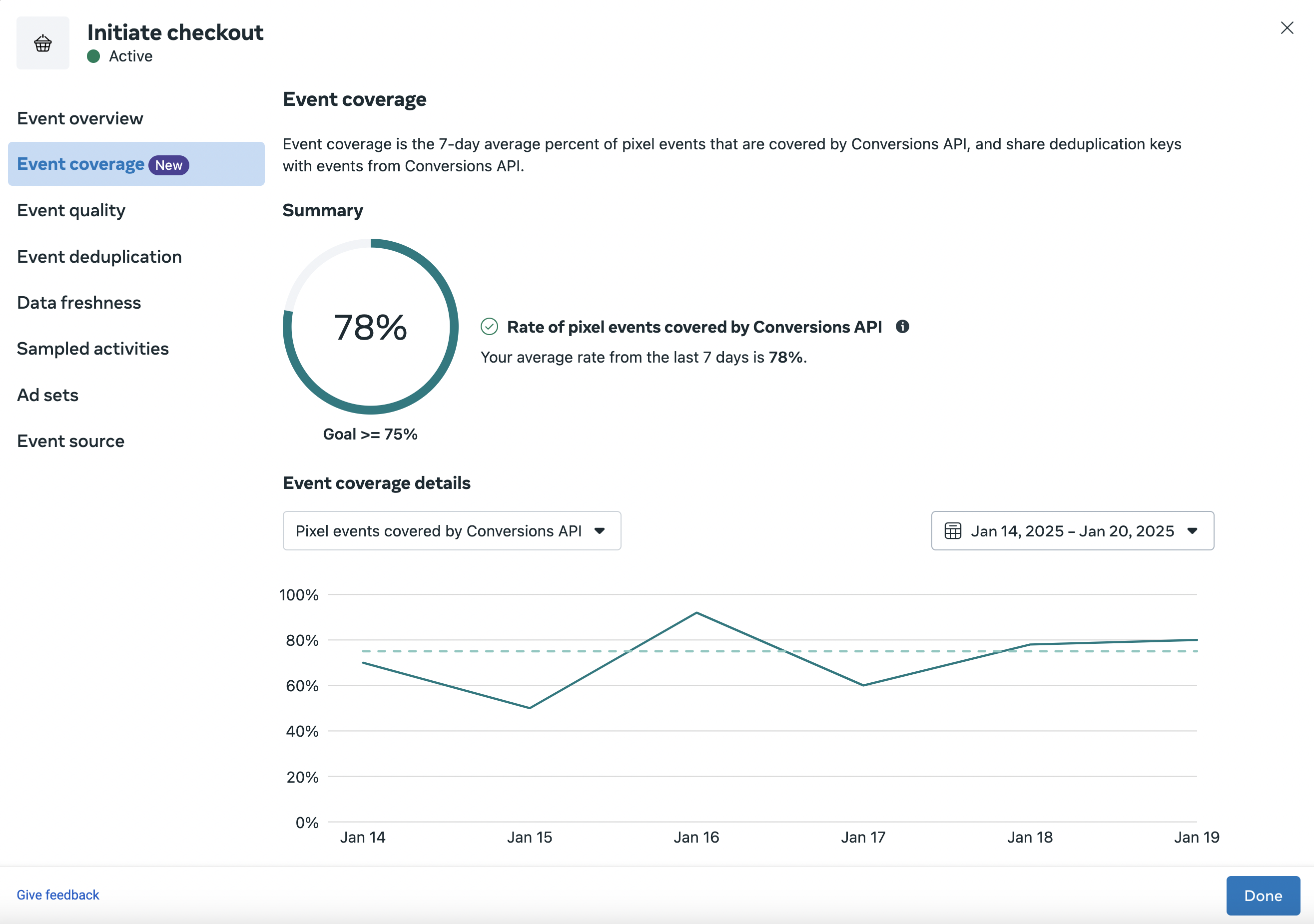
Consider a simple example. You can have a beautiful EMQ score, low coverage, and zero additional conversions reported. In that situation, the high EMQ doesn’t tell you whether the server connection is adding meaningful event coverage beyond what the browser already reports.
The useful distinction is that EMQ describes one aspect of event matching, while coverage and additional conversions reported tell you different things about the completeness of the server connection.
The perverse incentive nobody talks about
Here’s the part we ran into directly.
Pull up a PageView event in Events Manager and look at the data coming in on the event. You may see fields such as email, phone, first name, and last name missing from many PageView events.
A large share of the people hitting your site for the first time have never given you an email address. They’ve never bought. They’ve never opted in. If they haven’t identified themselves yet, you may simply have no email address to attach. That isn’t necessarily a tracking failure.
Those thinner events can still produce a lower EMQ and prompt Meta to recommend additional matching parameters.
So if you’re the vendor building the pipeline, and the EMQ score is what you’re graded on, an obvious move presents itself: stop sending the thin events.
Say you’ve registered 100 page views. Ninety-nine of them are anonymous: an IP and a user agent, maybe an fbp. Only one is from a known customer with email, phone, name, city, and a click ID.
Send all 100, and your EMQ for PageView is dragged down by the 99 anonymous events.
Send only the 1 known customer event, and your EMQ is excellent.
Same site, same traffic, same reality. One number went up. Your event coverage collapsed to 1%, and your additional conversions reported went with it. You’ve improved the displayed score by withholding the weaker events rather than improving the data attached to them.
This is Goodhart’s Law in action. The score became the target, so it stopped being a reliable measure.
What Meta said when we asked
We put this question to Meta directly while building our pipeline. The answer was one sentence: send everything you have, always.
Which makes sense the moment you stop looking at the score and start looking at coverage and additional conversions. Withholding otherwise valid events simply to protect the score can improve the dashboard while reducing server-side coverage.
Don’t turn off the browser pixel
One structural mistake makes all of this unmeasurable.
If you shut off browser-side tracking and run server-only, you lose the ability to compute additional conversions reported, because that metric exists by comparing what the server brought in against what the pixel already had. Kill the pixel, and there’s no baseline left to compare against.
For web events that can be sent through both channels, Meta recommends using browser and server connections together and deduplicating matching events. That typically requires the same event_name and event_id on the browser and server copies of the same action.
The six things EMQ doesn’t cover
- Capture every conversion you can. Coverage first.
- Send accurate event and customer data. Filling fields isn’t the goal. Filling them with true values is.
- Cover the same events on browser and server. Both pipelines, same event set.
- Deduplicate properly. Use consistent event names and event IDs across the browser and server copies of the same event so Meta can recognize the duplicate.
- Recover the conversions the browser loses. This is the entire economic case for a server-side connection, and additional conversions reported is how you verify it happened.
- Provide strong identifying information. This is what EMQ speaks to most directly. Our approach is to improve the identifiers attached to valid events rather than withholding events simply to protect the score.
What this looked like on a real account
One Kluvos merchant, before and after, roughly three to four weeks apart.
Before: the standard Shopify → Meta setup, browser pixel plus Shopify’s server-side connection. AddToCart event coverage sat at about 80%. On additional conversions reported, only one event type was showing any incremental value at all.
After: with our pipeline running, AddToCart coverage moved into the mid-to-high 90s. Additional conversions reported climbed sharply across the event set; the AddToCart figure came in near a 160% increase.
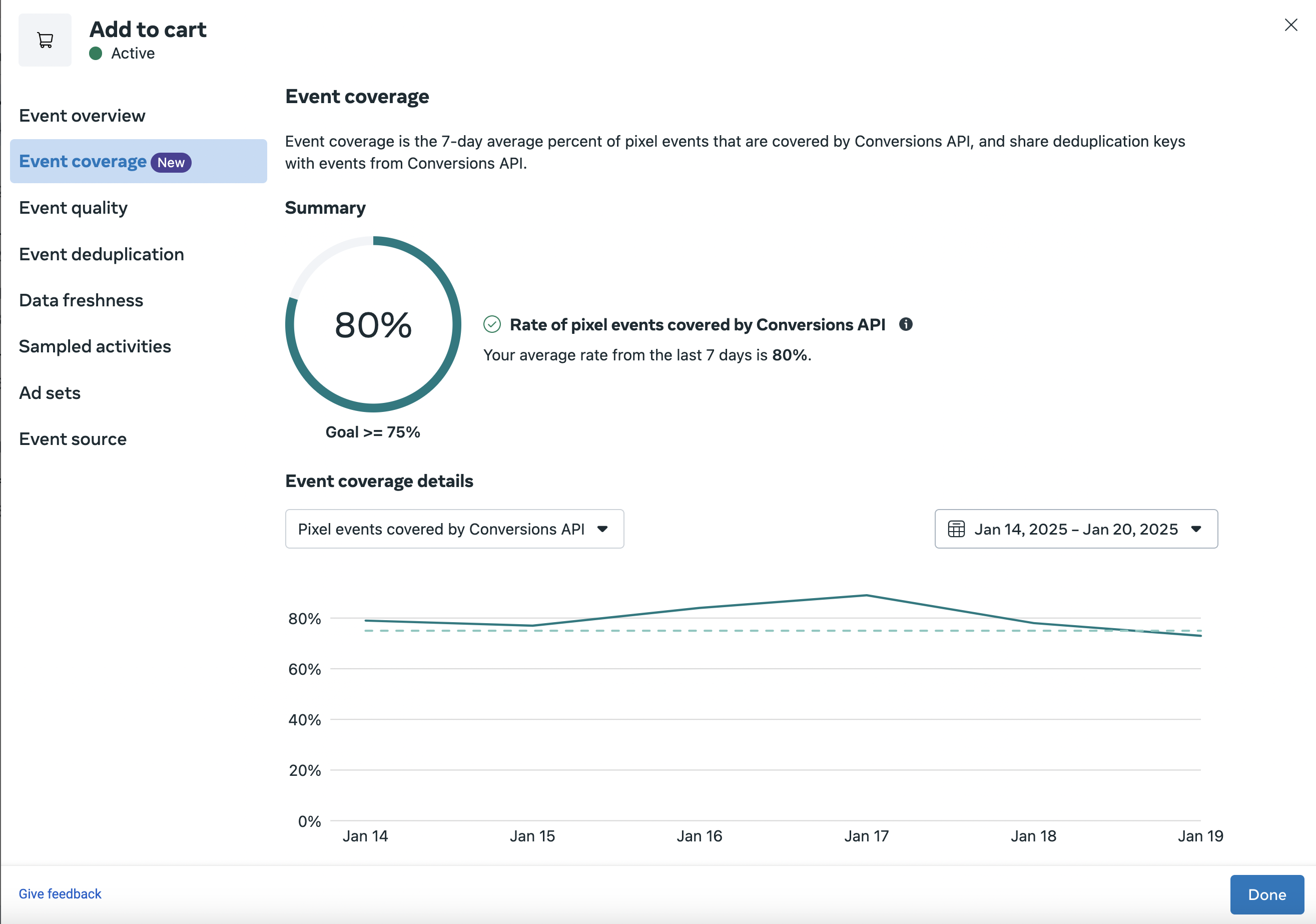
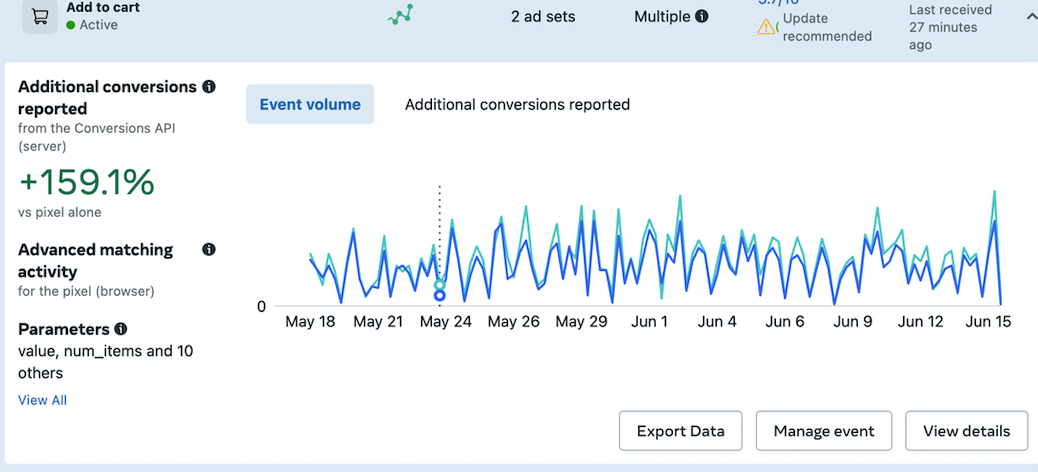
That’s one account, one time window, and we’d tell you to treat any single case study, including ours, as directional rather than predictive. The point is that we’re looking beyond “our EMQ is higher” to event coverage and additional conversions reported.
You can read more about these results in this NutSac case study.
What to do this week
- Open Events Manager and take note of the following three numbers per event type: EMQ, event coverage, and additional conversions reported. Not one number. Three.
- Confirm both pixel and CAPI are live on the same events, with deduplication configured. This means you should see events coming from both browser and server sources.
- Check each event for additional conversions reported. For any event where there were no additional conversions, this may indicate opportunity for improvement from a more robust server-side connection.
- If your EMQ improved recently, check whether server event coverage moved in the same direction or the opposite direction and make sure you still have browser events coming through.
- Once EMQ is stable—and stable is the bar, not 10 out of 10—stop looking at it and go work on coverage and additional conversions reported.
The score is what Meta shows you. The signal is what the algorithm runs on. Check the engine.
Sources
- Fahir Mehovic, Event Match Quality 10/10 Will Not Improve Your Meta Ad Performance, TrueMetriks, June 6, 2026.
- Meta Event Match Quality Score Explained, conversiontracking.io, May 20, 2025 (updated May 22, 2025).