

The problem
NutSac has spent a decade building a men's bag brand the slow way -- waxed canvas, full-grain leather, an audience that keeps coming back. NutSac's core marketing stack consisted of Klaviyo, Meta, and Shopify. The team was in the process of improving their email flows, but realized an inherent limitation to their stack. The stack didn't always know when an existing customer or email subscriber was on the site -- which meant lost revenue and a lack of visibility into their own customers' behavior.
The symptoms looked familiar: browse-abandonment and cart abandonment flows that had remained stagnant for years, a popup that had plateaued, and Meta's event manager reporting metrics that leaved room for improvement. NutSac was doing everything right with the system they had. The problem was more infrastructure-level. One of the key issues was that Klaviyo could only send to profiles it could identify -- which has become an increasing problem in todays internet landscape.
Kluvos allowed us to uncover existing Klaviyo profiles that were taking action on our site that we previously could not act upon. Kluvos also provided a shared information layer so that Kluvos' identity resolution and data-enhancements could be levearged across key parts of our marketing stack to improve our overall performance.
What we installed
Here's the setup: Kluvos' Shopify app, a custom Kluvos CAPI integration into Meta that replaced the standard Shopify/Meta CAPI integration, and a Kluvos popup that replaced the existing Klaviyo one. Every flow stayed virtually the same. No major template edits, no major creative changes inside of Klaviyo.
Three pieces went in under the hood:
- Identity recovery with deterministic + probabilistic stitching across devices including enabling Kluvos' AI events for Klaviyo.
- Server-side mirroring of every commerce event to Meta CAPI -- that now had shared context across the whole stack.
- Kluvos Popups, replacing the legacy popup with with one that contained a zero-party data layer that could be used to create new segments and flows in Klaviyo.
Klaviyo, in numbers
NutSac's Browse Abandonment, and Add-to-Cart flows had been running for years. The Kluvos team setup two additional flows or each flow type -- one triggered on the Kluvos server event, the other on the Kluvos AI event. In this way, each flow type was instantly super-charged with two additional, concurrent Kluvos flows running in parralel with the existing Klaviyo flow.
The browse-abandonment program -- historically a bottom-tier flow for NutSac -- quietly doubled its revenue per recipient. Add-to-cart climbed 80%. Both moves came from the same source: Klaviyo could now identify roughly twice as many people in each abandonment cohort, so the same emails now hit in roughly twice as many inboxes.
The 40x figure comes from single channel -- Klaviyo's own flow revenue numbers -- and ignores everything Kluvos contributed on the popup and paid side. The browse and cart lift alone covered the cost forty times over.
Popups, ~62% lift -- and a zero-party data layer.
NutSac's previous popup had plateaued. The Kluvos popup does two jobs at once: it captures the email, and it asks the visitor to self-segment. Each visitor walks through a short three-question opener -- product interest, material preference, intended use case -- before the email field. That data lands in Klaviyo as profile properties and powers segments NutSac couldn't build before.

Win a Free Bag!
First, tell us what you're most interested in:
What Material?
What material do you like the best?
How Will You Carry?
What's the bag mostly for?
The lift is real, but the bigger story is what each signup contained. Before Kluvos, NutSac knew it had an email. After Kluvos, NutSac knows the visitor wanted a leather satchel for daily commute -- three actionable properties on the profile before the first flow even fires. That becomes powerful segmentation in Klaviyo that can be used to target the Welcome flow from a generic "thanks for signing up" send into an interest-targeted, product-specific message.
The compounding effect matters too. Each captured profile becomes another identified browser, which fills out another browse-abandonment audience, which lands in another flow. The popup isn't a standalone channel -- it's a feeder for the abandonment flows that just doubled.
Meta, recovered
On the Meta side of things, the NutSac team was interested in seeing the impact Kluvos' infrastructure could have inside of the Meta Conversions API. So the existing Shopify/Meta CAPI integration was uninstalled and replaced with a custom Kluvos CAPI integration. The first thing that was visible was the increase this had on event coverage.
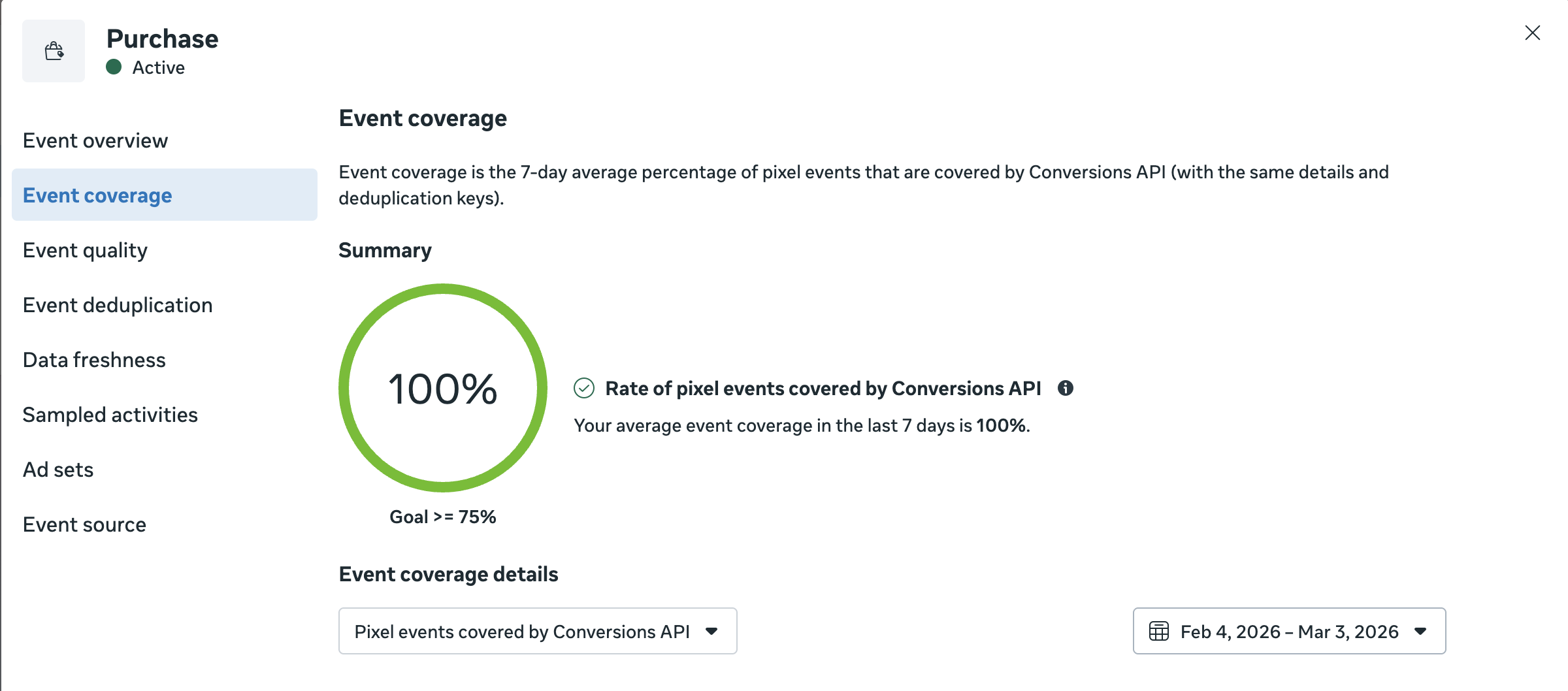
Event coverage: 86% → 100%
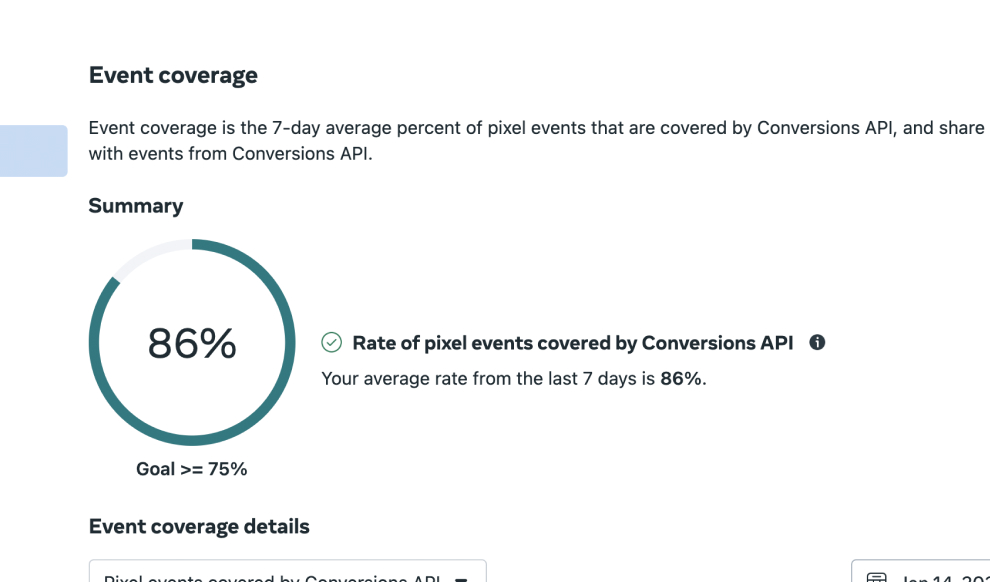
Event coverage is Meta's own measure of how complete your Conversions API stream is -- the share of pixel events that arrive with a matching server-side event, sharing the same deduplication key. Meta's stated goal is ≥75%. NutSac was already at 86% pre-Kluvos. Four weeks after install, the Purchase event was sitting at 100% -- every conversion the pixel saw, Meta also got server-side, with the rich parameters that browsers can no longer reliably send.
Additional conversions reported: +155.6%
The bigger lift is what Meta calls Additional conversions reported. It's the share of Purchase events that only the Conversions API caught -- sessions where the browser pixel was blocked, the device wasn't logged in, the referrer was stripped, or the journey crossed devices. Before Kluvos, those events were silently dropped. After Kluvos, Meta saw an extra 1.56 Purchase events for every 1 it was already catching with the pixel.
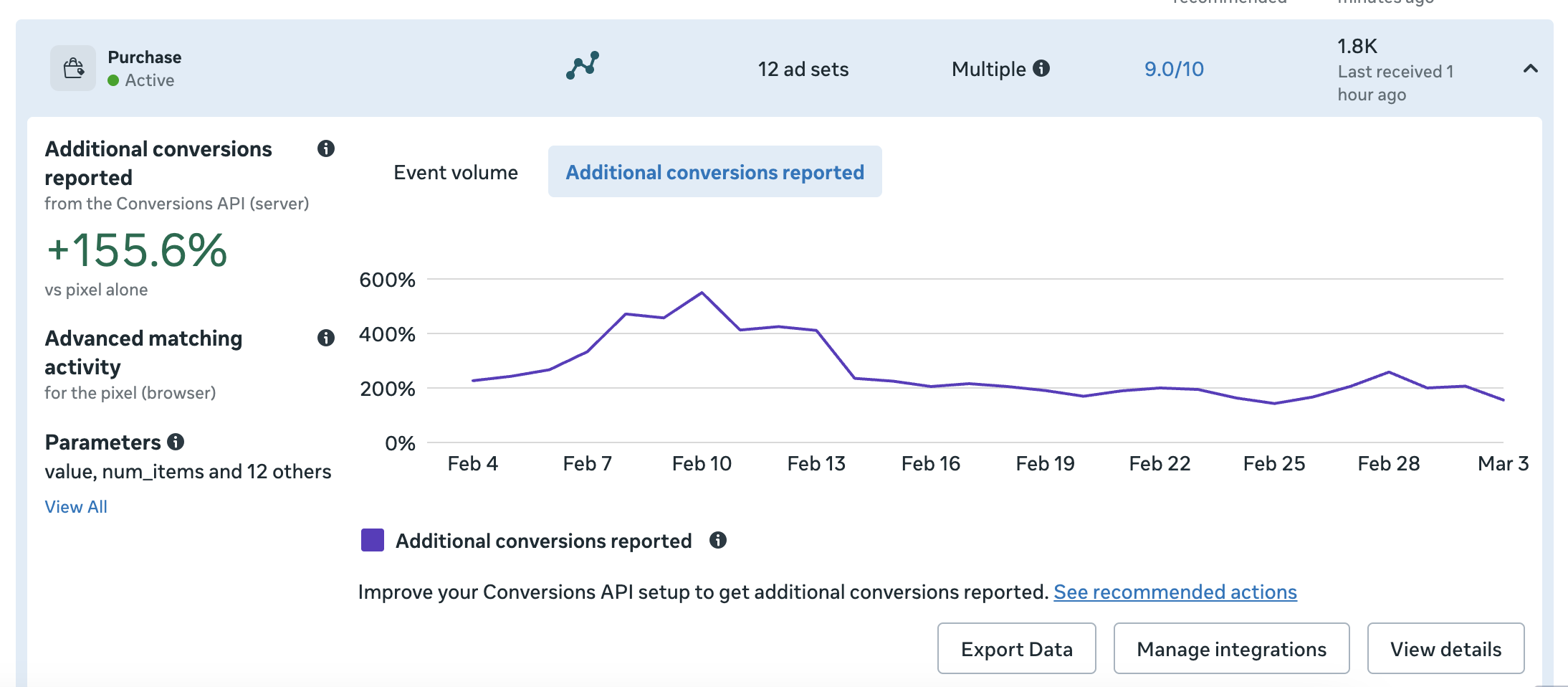
Purchase conversions reported via the Conversions API, vs. pixel aloneThe increase in both additional conversions reported and event coverage is a strong testimony to the value Kluvos' infrastructure can provide to the Meta Conversions API. These two metrics are Meta's own measurements of how complete their Conversions API stream is, and how well it matches the pixel events. Meta's algorithm gets clean signal, and the model optimizes against more complete and comprehensive data.
Where they are now
NutSac owned channels are doing more revenue against the same calendar of sends and the same paid budget. Kluvos just made sure the audience Klaviyo, Meta, and the team had been building for a decade was actually visible to the tools that needed it.
The outcome, in one line.
NutSac recovered the customers their stack had been quietly losing. Browse abandonment doubled, add-to-cart lifted 80%, popup opt-ins improved ~62%, and Meta started reporting bigger increases in additional conversions reported along with more complete event coverage. The Klaviyo lift alone paid for Kluvos forty times over.
Want results like NutSac's?
30 days. Zero risk. Full access to identity, attribution, popups, and the Meta CAPI stream.